Compare POS systems for Australian hospitality
Choosing a hospitality POS comes down to a few things: who controls your payments, what happens when the internet drops, who supports you and how costs change as you grow. See how the main types of POS compare, for single venues, hospitality groups and stadiums, and where PowerEPOS fits.
Australian-made since 1997, trusted by thousands of venues.
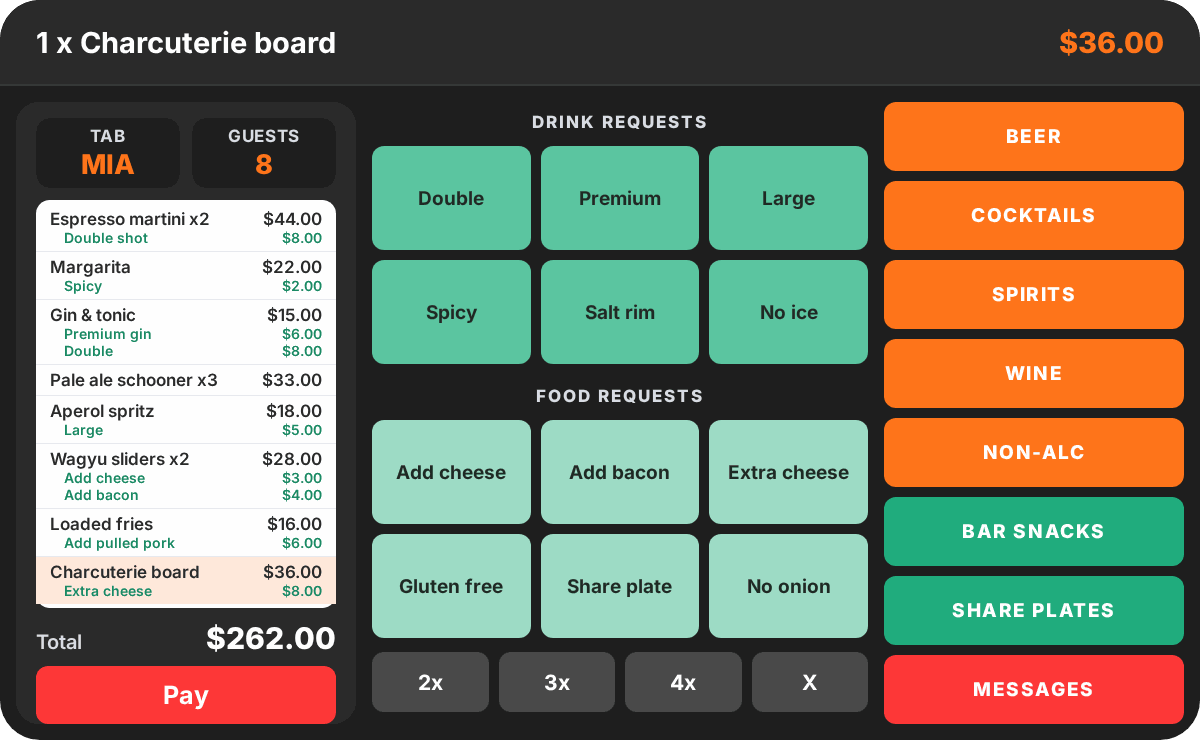
Trusted from cafés to stadiums







Including Nadia's Café, The Huskisson Hotel and more.
- 1,000's of Australian venues
- 20+ integrated payment providers
- Australian support, during and after hours
- Hospitality POS since 1997
POS comparison: how POS system types compare
Most hospitality POS systems fall into a few types. Here is how they typically compare on the things that affect your costs, reliability and support, from a single venue to a hospitality group or stadium.
| What to compare | Embedded payment POS | Cloud-only POS | PowerEPOS |
|---|---|---|---|
| Payment provider | Usually bundled with the POS provider's own payments | Varies, often a short list of approved providers | Your choice of 20+ integrated payment providers |
| Transaction fees to your POS provider | Often a margin on every card transaction | Varies by provider | None. Triniteq charges no transaction fees |
| Pricing model | Low upfront cost, with costs that rise as sales grow | Monthly subscription, often with paid add-ons | Predictable monthly licence that stays the same as sales grow |
| When the internet drops | Varies, offline features are often limited | Often limited or no trading until reconnected | Cloud-hybrid: keeps trading, then syncs when reconnected |
| Changing payment provider | Usually means changing your POS too | Depends on supported providers | Switch providers without changing your POS |
| Support | Varies, often offshore or chat-based | Varies, often offshore or chat-based | Australian-based support during and after hours |
| Built for | Often general retail and hospitality | Often general retail and hospitality | Hospitality only, from cafés to stadiums |
| Setup and training | Often self-setup | Often self-setup | Installed and trained remotely or on-site |
| Multi-site and head office control | Varies, often limited central control | Often available, sometimes as a higher-priced plan | Central menus and prices, site-level menus and prices, one login across venues |
| Group and venue reporting | Varies | Often available | Real-time group, site and area reporting with permission-based access |
| High-volume venues | Often designed for single counters | Depends on the internet under load | Every till keeps trading at stadium volumes, even when the network drops |
| Rollouts for groups and large venues | Usually self-managed | Usually self-managed | Project-managed rollouts with on-site installation and event-day support |
| Custom integrations | Rarely available | Usually limited to an app marketplace | Built by our Australian development team when you need them |
General comparison of POS system types in the Australian market. Features and pricing vary between providers, so check the details with any provider you are considering.
What makes PowerEPOS different
PowerEPOS keeps payments and POS separate, keeps trading offline and is backed by an Australian team, so you stay in control of your costs and your service.
Choose your own payment provider
PowerEPOS works with 20+ payment providers, so you choose the EFTPOS provider and negotiate the rates that suit your venue. If a better deal comes along, you can switch providers without changing your POS.
Triniteq charges no transaction fees. You pay one predictable monthly fee, so your POS costs don't rise as your sales grow.
Keeps trading when the internet drops
PowerEPOS is cloud-hybrid, so you keep taking orders and payments when the internet drops, and everything syncs back to the cloud once you are reconnected. You don't pay extra for it.
Australian support, during and after hours
Talk to a support team based in Australia, in your time zone, not an overseas call centre. Our team installs and trains remotely or on-site, and knows hospitality.
Australian-made since 1997
PowerEPOS is certified Australian Made by Triniteq, a hospitality POS company founded in Perth in 1997 and now supporting venues nationwide.
From cafés to stadiums
The same platform runs single cafés, multi-state hospitality groups, franchise networks and major stadiums, so you never outgrow it.
Questions to ask any POS provider
Whichever POS you are considering, these questions show the real cost and fit for your venue, group or stadium.
-
Can I choose my own payment provider?
If payments are bundled with the POS, you may not be able to shop around for better rates, and changing provider can mean changing POS.
-
Do you take a cut of every transaction?
Transaction-based pricing means your POS costs rise as your sales grow. A flat monthly licence keeps costs predictable.
-
What happens when the internet drops?
Ask whether you can keep taking orders and payments, printing dockets and running tabs offline, or only some of these.
-
Where is support based, and when is it available?
Hospitality runs nights and weekends. Check who answers the phone during service, and whether they know hospitality.
-
Will it grow with my business?
Check whether the same system can handle a second venue, head office reporting and higher volumes without a switch.
-
Who sets it up and trains my team?
A POS that is installed, configured for your menu and taught to your staff gets you trading faster than a self-setup kit.
For hospitality groups, franchises and stadiums, also ask
-
Can head office control menus and prices for every venue?
Check whether you can change items, prices and promotions once and send them to every site, while letting a venue keep its own menu or prices.
-
Can we see group, site and area reporting in real time?
Groups and large venues need sales by venue, area, product and staff as it happens, with access set by role.
-
Will every till keep trading at peak volume?
At a stadium or a busy group venue, ask what happens when the network is under load at half-time or the internet drops.
-
Who manages the rollout, and can you build integrations?
Ask who project manages a multi-site or stadium rollout, who supports you on major event days, and whether the provider can build custom integrations.
What venues say after switching to PowerEPOS
Venues that switched to PowerEPOS rate the smooth changeover, offline reliability and local support.
One big upside was the blended use of being server-based as well as cloud-based, so we have always up time. Being a very old building, that can be quite hard to achieve, so that was a big plus. The local factor was a big driving factor too.
This is my second venue working with Triniteq & PowerEPOS. The team are extremely responsive to feedback and are always willing to help you achieve your venue's goals. They work hard on a smooth transition to their platform, seamless integrations and venue support is always timely.
The roll over to PowerEPOS was smooth and totally uncomplicated, and very well supported by your wonderful team. Everything is great, and the back office is excellent and user-friendly.
Compare PowerEPOS for your type of venue
See how PowerEPOS is set up for venues like yours, from a single café to a stadium.
- Café POSCoffee rush, counter and table service, KDS for coffee and kitchen.See Café POS →
- Restaurant POSFloor plans, course firing, split bills and bookings integration.See Restaurant POS →
- Bar POSFast drinks service, bar tabs and happy hour pricing.See Bar POS →
- Pub & Hotel POSFront bar, pub meals and functions on one system.See Pub & Hotel POS →
- Hotel POSEvery outlet with PMS room charges and bill transfers.See Hotel POS →
- Event POSPOS hardware hire, daily licensing and live reporting.See Event POS →
- Multi-Site POSHead office control and reporting across every venue.See Multi-Site POS →
- Franchise POSBrand control, franchisee access and network reporting.See Franchise POS →
- Stadium & Arena POSHigh-volume service, live sales by area, every till trading.See Stadium & Arena POS →
How to switch to PowerEPOS
Switching POS is easier than most venues expect, and larger rollouts are project managed from start to finish. Here is how it works, in four steps.
-
01
Book a discovery call
Tell us about your venue, your current POS, hardware and payment provider. We will show you PowerEPOS set up for a venue like yours.
-
02
Keep your payment provider
Keep your current EFTPOS provider if it is one of our 20+ integrated providers, or choose a new one. It is your call.
-
03
Project-managed setup
A dedicated project manager plans your rollout, from one venue to a whole group or stadium. We set up your menus, screens and reporting, then install remotely or on-site, site by site. Use new hardware or compatible Windows devices you already own.
-
04
Trade with local support
Your team is trained before you go live, with Australian-based support during and after hours from then on.
Need hardware? Browse touchscreens, handhelds, printers and cash drawers in our POS hardware shop, or read about our support and training.
See how PowerEPOS compares for your venue
Talk to our Australian team on 1300 784 666
Comparing POS systems: FAQs
How do I compare POS systems for my hospitality business?
Compare how each POS handles payments, offline trading, support, pricing and growth. Check whether you can choose your own payment provider, whether the provider takes a cut of every transaction, what happens when the internet drops, where support is based and whether the system can grow with you.
What is the difference between embedded payment POS and payment-independent POS?
An embedded payment POS bundles card payments with the POS, so you use the provider's own payment service and rates. A payment-independent POS like PowerEPOS integrates with 20+ payment providers, so you choose your provider, negotiate your own rates and can switch providers without changing your POS.
What is the difference between cloud-only and cloud-hybrid POS?
A cloud-only POS relies on an internet connection, so trading can be limited when the connection drops. A cloud-hybrid POS like PowerEPOS keeps processing orders and payments offline, then syncs back to the cloud once you are reconnected.
Does PowerEPOS charge transaction fees?
No. Triniteq charges no transaction fees. PowerEPOS is a predictable monthly licence, so your POS cost stays the same as your sales grow. Card fees are set by the payment provider you choose.
What should hospitality groups look for when comparing POS systems?
Groups should compare head office control of menus and prices, site-level flexibility, real-time group and site reporting, user permissions by venue and who manages the rollout. PowerEPOS does all of this on one platform. See our multi-site POS and franchise POS.
What should stadiums and large venues look for when comparing POS systems?
Large venues should compare how the POS performs at peak volume, whether every till keeps trading when the network drops, reporting by area, event-day support and custom integrations. See our stadium and arena POS.
Can I keep my current payment provider if I switch to PowerEPOS?
In most cases, yes. PowerEPOS integrates with 20+ payment providers. See our integrations for the full list.
Can I use my existing hardware with PowerEPOS?
PowerEPOS runs on compatible Windows devices, so you may be able to keep some of your current hardware. We can also supply new POS terminals, printers and cash drawers.
How hard is it to switch POS systems?
Switching is easier than most venues expect. Our team sets up your menu, screens and reporting, installs remotely or on-site and trains your staff before you go live. Multi-site and stadium rollouts have a dedicated project manager who plans the changeover site by site, so service is not disrupted.
Is PowerEPOS suitable for my type of venue?
PowerEPOS runs cafés, restaurants, bars, pubs, hotels, events, multi-site groups, franchises and stadiums on the same platform. See the venue pages on this page for how it is set up for each.
How much does PowerEPOS cost compared with other POS systems?
PowerEPOS is a monthly software licence with no Triniteq transaction fees, so the total cost is predictable and does not rise with your sales. See current pricing on our POS pricing menu.
Is PowerEPOS made in Australia?
Yes. PowerEPOS is certified Australian Made and developed by Triniteq, which was founded in Perth in 1997 and now supports hospitality venues nationwide. Support comes from an Australian-based team, during and after hours.